
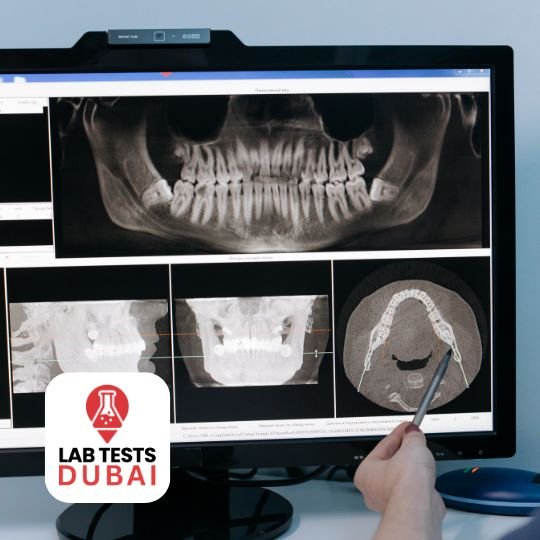
High-Resolution CBCT Scan for Upper & Lower Jaws – 3D Dental Imaging
650,00 د.إ
CBCT (Both Upper and Lower Jaws) provides high-resolution 3D imaging for precise dental diagnostics and treatment planning. It offers detailed visualization of bone structures, teeth, nerves, and sinuses with minimal radiation exposure. Key benefits include enhanced accuracy for implant placement, orthodontics, and surgical procedures, reducing risks and improving patient outcomes.
Description
CBCT Scan (Both Upper and Lower Jaws) – Precision 3D Imaging for Accurate Diagnosis
The Cone Beam Computed Tomography (CBCT) Scan of Both Upper and Lower Jaws delivers high-resolution, three-dimensional images of your teeth, jawbones, nerves, sinuses, and surrounding soft tissues — providing unparalleled clarity for accurate diagnosis and advanced treatment planning.
Unlike traditional 2D dental X-rays, this state-of-the-art imaging technology captures a full 360° view of your maxilla (upper jaw) and mandible (lower jaw), allowing dentists, oral surgeons, and orthodontists to assess bone density, nerve pathways, and tooth positioning with sub-millimeter precision.
At Lab Tests Dubai, our CBCT scans are performed using FDA-approved equipment with minimal radiation exposure, ensuring a fast, safe, and comfortable experience — essential for procedures like dental implants, orthodontics, root canals, and impacted wisdom tooth removal.
Why You Need This Test
You need a CBCT Scan of Both Jaws if:
- You’re planning dental implants and need precise bone evaluation
- You’re undergoing orthodontic or Invisalign® treatment
- You have impacted wisdom teeth near nerves or sinuses
- You suffer from TMJ pain, jaw dysfunction, or facial pain
- You require endodontic (root canal) treatment on complex molars
- You’ve had facial trauma or need reconstructive dental surgery
This scan eliminates guesswork, giving your dentist a complete 3D roadmap of your anatomy for safer, more successful outcomes.
Consider booking a CBCT scan if you experience:
- Pain or swelling around wisdom teeth
- Difficulty opening/closing your jaw (possible TMJ disorder)
- Loose or shifting teeth
- Previous failed root canals
- Numbness or tingling in the face or gums
- Planning cosmetic or restorative dental work
- Unexplained dental pain not visible on regular X-rays
These symptoms may point to hidden infections, cysts, nerve compression, or bone loss — only detectable through 3D imaging.
 What Happens If Untreated
 What Happens If Untreated
Ignoring undiagnosed dental issues due to lack of 3D imaging can lead to:
- Failed dental implants due to poor bone assessment
- Nerve damage during extractions or surgeries
- Chronic TMJ pain without proper diagnosis
- Spread of infection leading to abscesses or systemic illness
- Prolonged pain, misdiagnosis, and repeated treatments
A CBCT scan helps prevent complications, saving time, cost, and discomfort in the long run.
How to Prepare for the Test
Preparation is simple:
- No fasting required
- Remove metal objects: glasses, earrings, hearing aids, removable dentures, retainers
- Wear loose, comfortable clothing
- Inform us if you are pregnant or suspect pregnancy
- Continue taking your regular medications
The scan takes under 2 minutes — you’ll stand or sit still while the machine rotates around your head.
Test Overview
Test Name | CBCT Scan – Both Upper & Lower Jaws |
Imaging Type | Cone Beam Computed Tomography (3D) |
Area Scanned | Maxilla + Mandible (Full Jaws) |
Radiation Level | Up to90% lowerthan medical CT scans |
Duration | Less than 2 minutes |
Turnaround Time | DICOM files & report within24–48 hours |
Best For | Implants, orthodontics, wisdom teeth, root canals, TMJ, trauma |
Image Output | 3D volumetric data compatible with dental software (e.g., Nobel, 3Shape, Invisalign) |
FAQs
Q: Is a CBCT scan safe?
A: Yes. It uses very low-dose radiation — significantly less than hospital CT scans — and is considered safe for most patients.
Q: How is it different from a regular dental X-ray?
A: Regular X-rays show 2D flat images; CBCT provides 3D depth, width, and height, revealing hidden structures and spatial relationships.
Q: Can it detect tumors or cysts?
A: Yes. It’s highly effective at identifying cysts, tumors, infections, and bone abnormalities not visible on 2D films.
Q: Do I need a referral?
A: Recommended. Most dentists provide a prescription specifying the field of view (FOV). We accept self-referrals for screening purposes.
Q: Will my dentist get the results?
A: Yes. We provide DICOM files on USB and a radiologist report that you can share directly with your dental team.
Q: Can pregnant women get a CBCT scan?
A: Generally avoided unless absolutely necessary. Please inform us if you’re pregnant.
Q: Is it painful?
A: No. It’s completely non-invasive and painless — just hold still for a few seconds.
Book Your CBCT Scan Today! See every detail. Plan with confidence. Smile with certainty. The CBCT Scan (Both Jaws) gives your dentist the 3D clarity they need, so your implants, braces, or extractions go perfectly the first time.




Reviews
There are no reviews yet.