
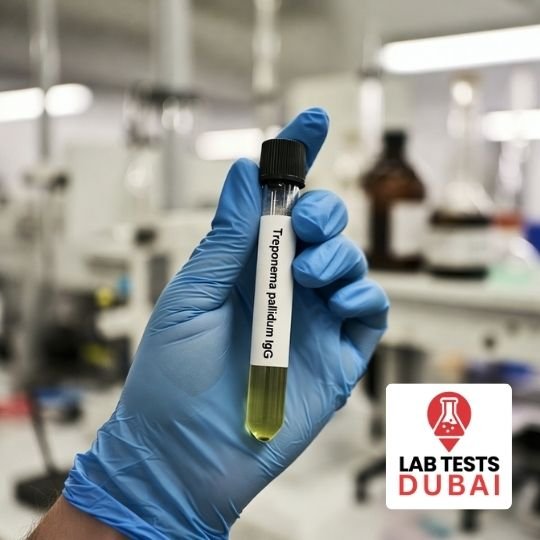
Treponema pallidum IgG
320,00 د.إ
The Treponema Pallidum IgG Test. It doesn’t hunt the bacteria itself; it searches for the permanent record your immune system creates upon encounter: the IgG antibody.
Sample Type : Serum
Methodology : Enzyme-immunoassay
TAT : 3 Days
Description
Treponema pallidum IgG Test
The first sign is often easy to miss, a small, painless sore in a hidden place. It appears, lingers, and vanishes on its own, creating a dangerous illusion of resolution. Meanwhile, a sophisticated invader, Treponema pallidum, has embarked on a silent campaign within. Its weapon is stealth. Its trajectory, if uncharted, can be devastating. This is syphilis, the “great imitator,” an infection whose true danger lies in its deceptive quiet.
In this shadowy landscape, guessing is not a strategy. You need a precise tool that can find the hidden footprints of the bacterium long after it has passed. That tool is the Treponema Pallidum IgG Test. It doesn’t hunt the bacteria itself; it searches for the permanent record your immune system creates upon encounter: the IgG antibody.
The Test That Reads the Archived Immune Response
When Treponema pallidum enters your body, your immune system launches a defense, crafting unique proteins called antibodies to tag and fight the invader. The IgG antibody is the body’s long-term memoir. It develops weeks after infection and, critically, persists for years, often for life.
This persistence is what makes the IgG test uniquely powerful. A positive result isn’t a simple “yes” to an active infection; it’s a nuanced readout of your immune history. It tells your clinician one of two critical stories:
An Active or Recent Infection: Your body is currently fighting, or recently fought, syphilis.
A Successfully Treated Past Infection: You were infected and treated in the past, and your immune system retains the memory.
This distinction is everything. It transforms the test from a mere diagnostic into a historical map and a monitoring guide, essential for staging the infection, confirming past exposure, and ensuring treatment was successful.
When This Test Is Your Essential Navigational Tool
Syphilis is a master of disguise. Its symptoms can mirror countless other conditions, or it can offer no symptoms at all for years. The Treponema Pallidum IgG test becomes your essential compass when:
A painless sore (chancre) appears and disappears, leaving uncertainty in its wake.
A mysterious rash emerges, particularly on the palms or soles, a classic, telltale sign of secondary syphilis.
You have a known exposure to a partner diagnosed with syphilis.
You are undergoing routine sexual health screening, which is recommended for sexually active individuals, especially those with new or multiple partners.
You are pregnant. Universal screening is critical, as untreated syphilis can be tragically passed to a baby (congenital syphilis).
You need to monitor treatment success after being diagnosed, ensuring the infection is responding to antibiotics.
It is the definitive step that moves a clinical suspicion into the realm of actionable, scientific fact.
The Grave Cost of Ambiguity
Syphilis untreated is a story told in worsening chapters. What begins as a solitary sore can evolve into a systemic illness with rashes and fevers, then retreat into a latent phase of silent damage, only to erupt years later as tertiary syphilis. This final act can be catastrophic, causing severe neurological damage (neurosyphilis), cardiovascular complications, and destruction of internal organs.
The window to prevent this progression is wide but fragile. The Treponema Pallidum IgG test is the key that unlocks that window, enabling simple, curative treatment with penicillin at the earliest possible stage. It is a test that doesn’t just diagnose an infection—it can prevent a lifetime of disability.
The Simple Procedure with a Profound Result
The test itself is straightforward: a standard blood draw from your arm. The science behind it, typically an enzyme-immunoassay (EIA), is where the elegance lies. This sensitive method detects the specific IgG “signature” against Treponema pallidum in your serum. Within about three days, this small sample can provide a result that directs your entire care pathway, offering clarity and a clear way forward.
Knowledge as the Cornerstone of Sexual Health
Choosing to take this test is an act of profound self-care and responsibility. In an era where sexual health is integral to overall wellness, precision testing removes stigma and replaces it with empowerment. It acknowledges that syphilis, while serious, is simple to cure when accurately identified.
If you have a concern, whether from a symptom, an exposure, or simply the prudent desire for a complete health picture, this test will help you gain clarity. Your body keeps a meticulous record. For the sake of your long-term health, ensure that record is read.
Frequently Asked Questions – Treponema pallidum IgG Test
What is the Treponema pallidum IgG test?
This blood test detects Immunoglobulin G (IgG) antibodies against Treponema pallidum, the bacterium that causes syphilis. IgG antibodies develop weeks after infection and typically remain in the bloodstream for life, even after successful treatment. This makes the test ideal for confirming past or chronic syphilis exposure.
When should I take this test?
This test is recommended if you:
– Had symptoms of syphilis (sores, rash) in the past
– Are undergoing routine STI screening (e.g., pre-marital, prenatal, or occupational)
– Have a partner diagnosed with syphilis
– Need to confirm prior infection for medical records
– Are being evaluated for late-stage or latent syphilis
It is not ideal for diagnosing acute infection, use the Treponema pallidum IgM test for that instead.
How does IgG differ from IgM in syphilis testing?
IgM appears early (within 1–2 weeks) and indicates recent or active infection.
IgG develops later (after 3–4 weeks) and persists for years, even after cure, making it a marker of past exposure or resolved infection.
Many clinicians use **both tests together** to determine whether an infection is new, ongoing, or historical.
Do I need to fast before the test?
No fasting is required. A simple blood draw is all that’s needed. No special preparation is necessary.
What does a positive IgG result mean?
A positive IgG result means you’ve been infected with syphilis at some point in your life. It does not distinguish between current and past infection. If you’ve never been treated, you may still have active disease. If you were treated, the antibodies may simply reflect immune memory. Your doctor will correlate this with clinical history, RPR/VDRL titers, and symptoms to determine next steps.
How soon will I get my results?
Thanks to enzyme-immunoassay methodology, results are typically available within 3 business days. You’ll receive a secure digital report to share with your doctor, who can guide treatment or confirm clearance if previously treated.

Reviews
There are no reviews yet.