
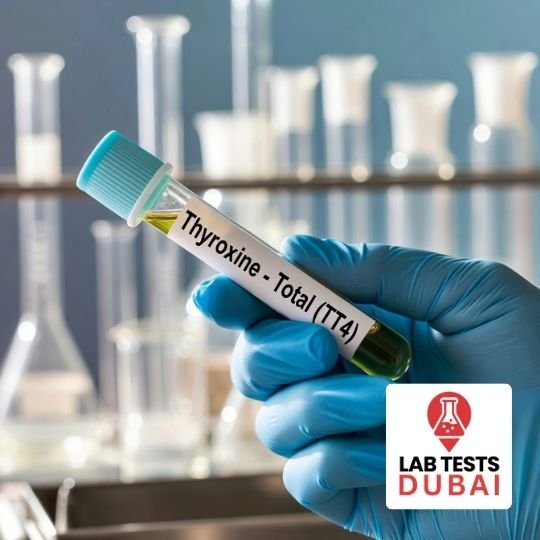
Thyroxine – Total (TT4) Lab Test
130,00 د.إ
The Thyroxine – Total (TT4) Lab Test is a comprehensive diagnostic tool designed to measure the complete levels of this hormone in your blood. While “Free” T4 measures just the active hormone, the TT4 measures the total supply.
Sample Type : Serum
Methodology : Chemiluminescence
TAT : 1 Day
Description
Thyroxine – Total (TT4) Lab Test
You feel like you are constantly fighting your own biology. One day you are dragging yourself through a fog of fatigue, watching the scale climb despite eating less. The next, your heart is racing for no reason, your hands are trembling, and anxiety feels like your baseline setting.
This is the paradox of a thyroid disorder. It can either slow your engine down to a crawl or send it into overdrive.
At the center of this chaos is Thyroxine, commonly known as T4. It is the primary hormone produced by your thyroid gland, the fuel that drives your metabolism, your heart rate, and your energy.
The Thyroxine – Total (TT4) Lab Test is a comprehensive diagnostic tool designed to measure the complete levels of this hormone in your blood. While “Free” T4 measures just the active hormone, the TT4 measures the total supply. It provides a foundational view of your thyroid’s output, offering critical insights for diagnosing hypo- and hyperthyroidism.
If you are ready to decode the mystery of your symptoms, this test is your starting point.
Why You Need the “Total” View
Your thyroid is a small, butterfly-shaped gland in your neck, but it acts as the master regulator for your entire body. When it functions correctly, you have energy, your hair is thick, your weight is stable, and you feel like yourself.
When it malfunctions, everything breaks down.
The TT4 test is vital because it assesses the overall production capacity of your thyroid. It measures both the hormone that is actively working and the hormone that is bound to proteins in your blood, waiting to be used.
You need this test to:
- Diagnose Thyroid Disorders: It is a primary tool for identifying hypothyroidism (underactive thyroid) and hyperthyroidism (overactive thyroid).
- Monitor Treatment: If you are already on thyroid medication, this test helps ensure your dosage is correct.
- Understand the Context: Often paired with TSH (Thyroid Stimulating Hormone), TT4 gives doctors a complete picture of the feedback loop between your brain and your thyroid.
The Body’s Alarm System: Symptoms You Can’t Ignore
Thyroid imbalances are notorious for mimicking other conditions. However, they usually present as a distinct set of contrasting patterns.
Signs of Low TT4 (Hypothyroidism):
- Unexplained weight gain.
- Chronic fatigue and sluggishness.
- Intolerance to cold.
- Dry, pale skin and brittle nails.
- Thinning hair.
- Depression and “brain fog.”
Signs of High TT4 (Hyperthyroidism):
- Unexplained weight loss despite a good appetite.
- Rapid or irregular heartbeat (palpitations).
- Anxiety, irritability, and nervousness.
- Increased sweating and heat intolerance.
- Tremors in the hands.
- Difficulty sleeping.
If you see yourself in these lists, your body is signaling that the master regulator is off-balance.
The Biological Assembly Line: Natural Production
To understand the test, you have to understand the hormone.
Thyroxine (T4) is produced in the thyroid gland, but the orders come from the brain. The pituitary gland releases Thyroid Stimulating Hormone (TSH), which tells the thyroid how much T4 to manufacture.
Once T4 is released into the bloodstream, it mostly attaches to proteins, acting like a fleet of trucks transporting the fuel. A small portion remains “free” to enter cells immediately. Your body eventually converts T4 into T3, the even more active form that revs up your metabolism.
Factors like iodine deficiency (the fuel for the thyroid), autoimmune attacks (like Hashimoto’s or Graves’ disease), chronic stress, and certain medications can disrupt this assembly line, leading to abnormal TT4 levels.
The Stakes of Ignoring the Imbalance
Why is it so important to diagnose this? Because an untreated thyroid imbalance is a systemic threat.
If Hypothyroidism is ignored: Your metabolism slows down permanently. This can lead to high cholesterol, heart disease, severe depression, and a life-threatening condition called myxedema coma.
If Hyperthyroidism is ignored: Your body acts as if it is in a constant state of fight-or-flight. This can lead to dangerous arrhythmias, osteoporosis (bone loss), muscle wasting, and a “thyroid storm”, a sudden, acute exacerbation that can be fatal.
Furthermore, untreated thyroid issues are a leading cause of infertility and pregnancy complications. The TT4 test is the step that prevents these outcomes.
How to Prepare for Accuracy
Getting a clear read on your thyroid health is straightforward, but precision matters.
- Fasting: Generally, no fasting is required.
- Medication Protocol: This is critical. If you are taking thyroid medication, ask your doctor if you should skip your dose on the morning of the test. Taking it too close to the blood draw can artificially inflate your results.
- Supplement Review: Be sure to inform your provider about any supplements, particularly biotin, which can interfere with thyroid testing.
The Technology of Speed and Precision
We utilize advanced chemiluminescence technology to analyze your serum. This method is highly sensitive, capable of detecting minute variations in hormone levels with exceptional accuracy.
Test Overview:
- Sample Type: Serum
- Methodology: Chemiluminescence
- Turnaround Time (TAT): 1 Day
With results available in just 24 hours, you don’t have to wait in limbo. You get the data you need to adjust your lifestyle, diet, or medication immediately.
Take Control of Your Metabolic Health
Don’t dismiss fatigue as “just getting older” or anxiety as “just stress.” Your thyroid is the thermostat of your life, and it deserves a check-up.
Whether you are navigating unexplained symptoms, managing a chronic condition, or simply taking a proactive stance on your health, the Thyroxine – Total (TT4) lab test is an essential part of your wellness toolkit.
Get the answers you deserve.
Book your lab test online to schedule your Thyroxine – Total (TT4) test today. Reclaim your balance, your energy, and your peace of mind.
Frequently Asked Questions – Thyroxine – Total (TT4) Lab Test
What is Total T4 (Thyroxine)?
Total T4 measures the entire amount of thyroxine in your blood, both the portion bound to carrier proteins (like TBG) and the small fraction that is free and biologically active. It reflects your thyroid gland’s overall hormone production but does not directly indicate how much hormone is available for your body to use.
Why test Total T4 instead of Free T4?
Total T4 is often used when evaluating conditions that affect thyroid-binding proteins, such as pregnancy, estrogen therapy, liver disease, or genetic disorders. In these cases, Free T4 may appear normal while Total T4 is elevated or reduced. However, for most people, Free T4 is a more accurate indicator of thyroid function because it measures only the active hormone.
What symptoms might prompt this test?
High Total T4: anxiety, weight loss, rapid heartbeat, tremors, heat intolerance.
Low Total T4: fatigue, weight gain, cold sensitivity, dry skin, depression, constipation.
Note: Symptoms must be interpreted alongside TSH, Free T4, and clinical context, especially if you’re pregnant or on hormone therapy.
Do I need to fast before the test?
No fasting is required. However, avoid taking biotin supplements for at least 48 hours before your blood draw, as high doses can interfere with thyroid immunoassays. If you’re on thyroid medication, take it after your test unless your doctor advises otherwise.
How soon will I get my results?
Thanks to advanced immunoassay methodology, results are typically available within 1 business day. You’ll receive a secure digital report with your Total T4 level and reference range, ideal for sharing with your endocrinologist or primary care provider.
Is Thyroxine – Total (TT4) Lab Test enough to assess thyroid health?
No. Total T4 should always be interpreted alongside TSH and Free T4. For example:
– High Total T4 with normal TSH/Free T4 may indicate elevated binding proteins (e.g., during pregnancy).
– Low Total T4 with normal Free T4 may occur in chronic illness or malnutrition.
For a complete picture, consider our Comprehensive Thyroid Package.
Reviews
There are no reviews yet.