
Potassium (K) Serum Test – Ion-Selective Electrodes Methodology
100,00 د.إ
The Potassium (K) Serum Test is the definitive way to check your battery. Using the advanced Ion-Selective Electrodes (ISE) methodology
Sample Type : Serum
Methodology : Ion-Selective Electrodes
TAT : 1 Day
Description
Potassium (K) Serum Test – Ion-Selective Electrodes Methodology
We’ve all heard the old advice: “Eat a banana if you have a cramp.”
It’s folk wisdom that has some truth to it, but it drastically oversimplifies the situation. Potassium isn’t just a nutrient found in fruit; it is one of the most critical electrolytes in the human body. It is the spark that powers your nerves, the fuel that flexes your muscles, and the regulator that keeps your heart beating in a steady rhythm.
When those levels drop, or spike dangerously high, your body feels it. And sometimes, the consequences are silent but deadly.
The Potassium (K) Serum Test is the definitive way to check your battery. Using the advanced Ion-Selective Electrodes (ISE) methodology, this test offers a precise reading of your electrolyte balance in just 1 Day.
It’s not about guessing; it’s about knowing.
The Electricity of You
To understand why Potassium is vital, you have to think of your body as an electrical machine.
Your heart beats because of an electrical signal. Your muscles contract because of an electrical command. Your nerves send messages because of an electrical current.
Potassium is positively charged and sits inside your cells. Its partner, Sodium, sits outside. The dance of these two ions moving in and out of cells is what generates every spark of electricity in your body.
If the balance is off, the short circuits happen.
The “Silent” Dangers of Imbalance
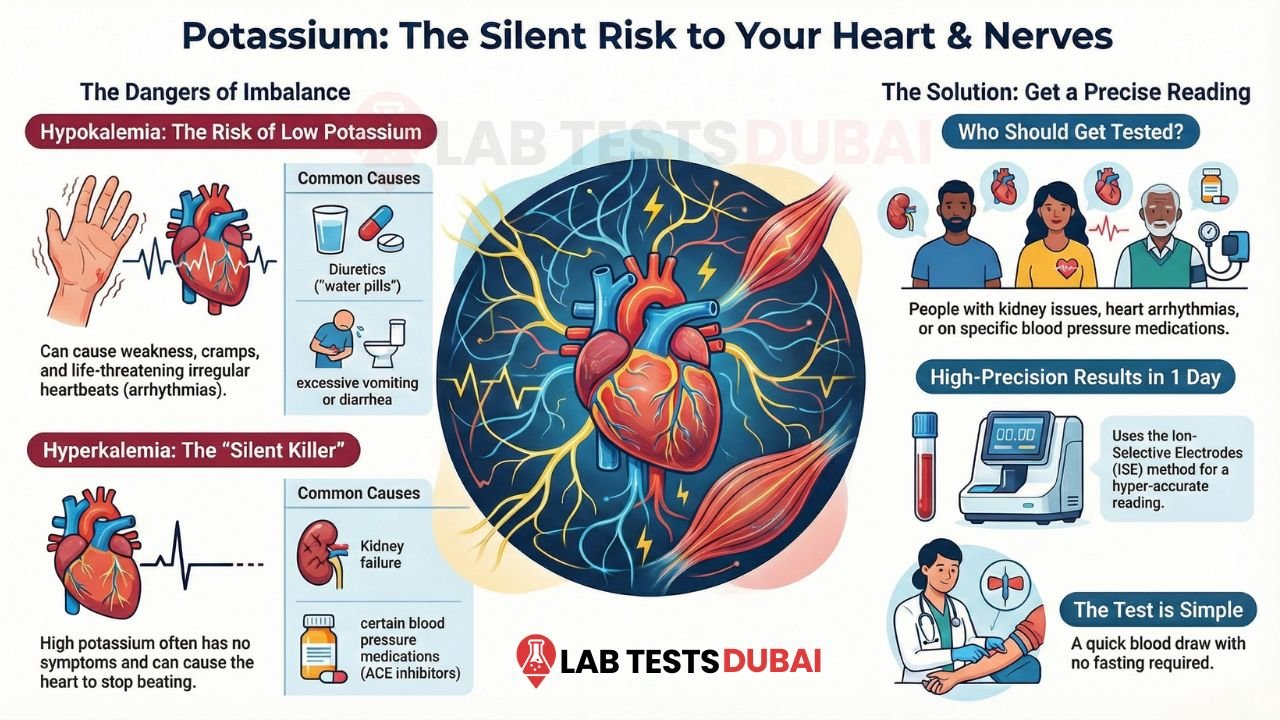
Imbalances usually fall into two categories: Hypokalemia (Low) and Hyperkalemia (High). Both are dangerous, but for different reasons.
1. Hypokalemia (Low Potassium)
- The Feeling: Weakness, cramping, fatigue, constipation.
- The Danger: It affects your heart muscles. In severe cases, it can lead to arrhythmias, irregular heartbeats that can be life-threatening.
- The Cause: Often caused by diuretics (water pills for blood pressure), excessive vomiting/diarrhea, or just not getting enough in your diet.
2. Hyperkalemia (High Potassium)
- The Feeling: Often, nothing until it’s too late. You might feel weakness or tingling, but often the first sign is a heart issue.
- The Danger: This is the “Silent Killer.” High potassium stops your heart from beating. It is a common complication in Kidney Disease because if your kidneys can’t filter out the excess, it builds up in your blood.
- The Cause: Kidney failure, certain medications (like ACE inhibitors), or Addison’s disease.
Why “Ion-Selective Electrodes” Matters
You might wonder, “Why specify the method? A blood test is a blood test.”
In laboratory science, accuracy is everything. The Ion-Selective Electrodes (ISE) methodology is like using a high-precision tuning fork instead of just listening by ear. It uses a specialized membrane that is selectively permeable to Potassium ions. It ignores the “noise” of other elements in your blood serum to give a hyper-accurate reading of Potassium concentration.
This precision is crucial because the “normal range” for Potassium is narrow. Even a small deviation can be clinically significant.
Who Is This Test For?
This isn’t just a random check-up; it is targeted monitoring.
You should consider the Potassium (K) Serum Test if:
- You take Blood Pressure Meds: specifically Diuretics (water pills) or ACE inhibitors. These can drastically alter Potassium levels.
- You have Kidney Issues: Your kidneys are the gatekeepers of Potassium. If they are failing, Potassium builds up.
- You have Heart Arrhythmias: If your heartbeat skips or flutters, electrolyte imbalance is often the culprit.
- You are “Salt Sensitive”: If you have high blood pressure and are on a restricted diet, monitoring Potassium is part of the picture.
- You have Unexplained Cramps: If you are an athlete or just waking up with severe charlie horses, low Potassium might be the cause.
The Cost of Guessing
“I eat healthy, so I must be fine.”
This is a dangerous assumption. You can eat bananas every day, but if your kidneys are leaking Potassium faster than you can eat it, you are deficient. Or, you might be taking a supplement thinking “more is better,” not realizing your kidneys can’t process it, pushing you toward hyperkalemia.
The cost of guessing isn’t just feeling tired. It’s a trip to the ER for a heart arrhythmia. It’s a muscle tear from a cramp during a workout. It’s a progression of kidney disease because electrolytes weren’t managed.
How to Prepare and What to Expect
The process is designed to fit into your life easily.
- Preparation: No fasting is required. You can eat and drink normally. Just make sure your doctor knows about any supplements you are taking.
- The Test: A simple blood draw (serum).
- The Speed: Using the ISE method, Lab Tests Dubai delivers your results in just 1 Day.
In a situation where Potassium levels can fluctuate, a 1-day turnaround allows your doctor to adjust medications or supplements immediately.
Charge Your Battery
Your body is an incredible machine, but it runs on specific fuel. Don’t let a fixable imbalance dim your spark.
Whether you are managing a heart condition, monitoring kidney health, or just trying to optimize your performance, the Potassium (K) Serum Test gives you the data you need.
Don’t guess. Test.
Book your Potassium (K) Serum Test with Lab Tests Dubai today
Frequently Asked Questions – Potassium (K) Serum Test
What is a Potassium (K) Serum Test?
The Potassium Serum Test measures the level of potassium in your blood, an essential electrolyte responsible for nerve function, muscle contraction, and maintaining a healthy heart rhythm.
Why is the Potassium test important?
Abnormal potassium levels can indicate kidney problems, dehydration, adrenal disorders, or medication side effects. Both high and low potassium levels can affect heart function and require prompt treatment.
How is the Potassium test performed?
The test is done through a simple blood sample analyzed using the Ion Selective Electrodes (ISE) methodology, which provides fast and accurate electrolyte measurements.
Do I need to fast before the test?
No fasting is usually required unless your doctor has ordered additional tests that require fasting.
What symptoms indicate I may need this test?
Symptoms such as fatigue, weakness, muscle cramps, irregular heartbeats, nausea, or changes in blood pressure may indicate abnormal potassium levels.
How long does it take to get the results?
Results are typically available within 1 day, making it easy to identify and manage potassium imbalances quickly.
Can medications affect potassium levels?
Yes. Diuretics, blood pressure medications, steroids, and certain supplements can influence potassium levels. Inform your doctor about any medicines you are taking.
Is this test suitable for routine health checkups?
Yes, potassium testing is commonly included in routine wellness panels to monitor kidney function and overall electrolyte balance.
Do I need a doctor’s referral to book this test?
No referral is required. You can book the Potassium (K) Serum Test directly through Lab Tests Dubai.
Can the test detect life-threatening electrolyte imbalances?
Yes. Severely high or low potassium levels can be dangerous and require immediate medical attention. This test helps identify such conditions early.

Reviews
There are no reviews yet.