
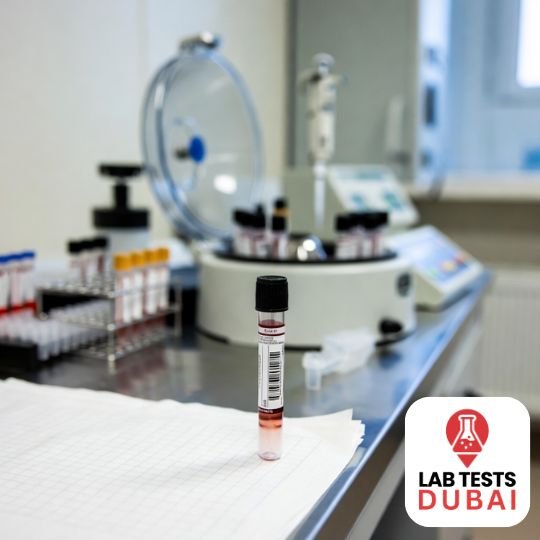
BCR-ABL Quantitative Test | Accurate Monitoring for Leukemia Detection
3.250,00 د.إ
The BCR/ABL – Quantitative test is a highly sensitive molecular diagnostic assay used to detect and quantify the BCR-ABL fusion gene, a key biomarker in chronic myeloid leukemia (CML) and some acute lymphoblastic leukemias (ALL). Utilizing real-time PCR technology, it provides precise measurement of BCR-ABL transcript levels, enabling accurate disease monitoring and treatment response assessment.
Sample Type : Whole Blood
Methodology : Real time PCR
TAT : 8-10 Days
Description
BCR/ABL Quantitative Lab Test – Critical Monitoring for Leukemia Patients
The moment you hear the words “Chronic Myeloid Leukemia” (CML), your world stops. It’s a diagnosis that carries the heavy weight of the word “cancer.”
But here is the modern medical reality that many patients don’t realize immediately: CML is different.
For decades, leukemia was a battle fought with toxic chemotherapy. Today, for 95% of CML patients, the treatment is a pill. A specific, targeted pill that blocks the engine driving the cancer.
But there is a catch. The pill isn’t a cure that you take for a week and forget. It is a lifelong companion (or until you reach deep remission). And taking it blindly is dangerous.
You need to know if it’s working. You need to know if your body is fighting back. You need to measure the invisible.
This is why the BCR/ABL Quantitative Test is not just a routine check-up. It is the most critical metric in your life.
The “Philadelphia” Swap
To understand why this test is vital, you have to understand the microscopic accident that causes CML.
Inside your bone marrow, a swap occurred between Chromosome 9 and Chromosome 22.
- Part of chromosome 9 breaks off and attaches to chromosome 22.
- This new, fused Frankenstein chromosome is called the Philadelphia Chromosome.
It creates a mutant gene called BCR-ABL. Think of this gene as a broken switch that is stuck in the “ON” position. It pumps out a protein (a tyrosine kinase) that screams at your bone marrow: “Divide! Divide! Divide!”
The result? An avalanche of white blood cells you don’t need.
Why “Quantitative” Changes Everything
Standard genetic tests often give you a Yes or a No. “Do you have the mutation?” Yes.
But the BCR/ABL Quantitative Test goes deeper. It asks: “How much of the mutation is left?”
It measures the amount of the BCR-ABL transcript in your blood. This is the difference between knowing there is a fire and knowing exactly how hot the flames are.
Using Real-Time PCR (Polymerase Chain Reaction), this test counts the cancer cells down to the tiniest fraction. It allows your oncologist to categorize your response into “Molecular Responses”:
- Major Molecular Response (MMR): The cancer is reduced by 1,000 times (3-log reduction).
- MR4 / MR4.5: The cancer is reduced by 10,000 to 100,000 times. It is barely detectable.
Why does this matter? Because hitting these deep targets is the only way to ensure long-term survival.
The Holy Grail: Treatment-Free Remission (TFR)
Every CML patient dreams of the day they can stop taking their medication.
Decades ago, this was impossible. Today, thanks to precise monitoring with the BCR/ABL test, roughly 50-60% of patients who maintain a deep, undetectable molecular response for years can attempt Treatment-Free Remission (TFR).
They get to stop the pills.
But you cannot attempt this safely without the data. You need the proof that the Philadelphia chromosome has been silenced. The BCR/ABL test is your golden ticket to a life without daily medication.
The Danger of Silence
If you have CML, the “Silent Killer” isn’t the disease itself—it’s Resistance.
The leukemia cells are smart. Over time, they can mutate. The keyhole (the BCR-ABL protein) changes shape, and your key (the pill like Imatinib or Dasatinib) no longer fits.
If you stop testing, you won’t feel this happening immediately. You might feel fine for months. But inside, the cancer is roaring back.
The BCR/ABL Quantitative Test acts as an early warning system. It detects rising numbers long before your blood counts crash or you feel sick. It allows your doctor to switch your medication to a different drug that works, stopping the relapse in its tracks.
Monitoring: The New Normal
Living with CML means shifting your mindset from “Patient” to “Manager.”
Your routine becomes:
- Take your pill.
- Get your BCR/ABL test every 3 months (or as directed).
- Check the number.
If the number is stable or dropping, you live your life. You work, you travel, you love. The anxiety of “what if” fades into the background because you have the data.
The Lab Tests Dubai Advantage
We know that living with a chronic condition is exhausting. The last thing you need is the stress of hospital logistics.
Lab Tests Dubai brings precision diagnostic technology to your terms.
- Home Collection: No waiting rooms. No exposure to infections. You can have your blood drawn in the comfort of your home.
- Speed & Accuracy: Using advanced PCR technology, we deliver results in 8–10 days.
- Reporting: We provide your results on the International Scale (IS), so your oncologist can compare your numbers against global standards instantly.
Don’t Fear the Number
In the beginning, the percentage on your BCR/ABL report might look scary. But over time, that number becomes your friend.
It is proof that your treatment is working. It is the countdown to remission. It is the shield that protects your future.
Take control of your journey. Ensure your invisible enemy is staying silent.
BCR-ABL Quantitative Test – Frequently Asked Questions
1. What is the BCR-ABL Quantitative Test?
The BCR-ABL Quantitative Test is a highly sensitive PCR test used to detect and measure the BCR-ABL gene fusion associated with chronic myeloid leukemia (CML) and some types of acute lymphoblastic leukemia (ALL). It helps monitor treatment response and disease progression.
2. Why is the BCR-ABL test important?
This test plays a crucial role in diagnosing leukemia, evaluating how well treatment is working, adjusting medication dosage, and detecting early resistance to therapy.
3. Who should take the BCR-ABL Quantitative Test?
Individuals diagnosed with CML, suspected leukemia patients, or those undergoing targeted therapy such as tyrosine kinase inhibitors (TKIs) are advised to take this test regularly.
4. How is the BCR-ABL test performed?
A blood sample is collected, and advanced real-time PCR technology is used to measure the quantity of BCR-ABL transcripts, providing an accurate assessment of disease activity.
5. What do the BCR-ABL test results mean?
Results indicate the level of BCR-ABL gene expression. A decreasing level typically means treatment is working, while rising levels may suggest disease progression or resistance to medication.
6. How long does it take to receive the results?
Results are generally available within 5–7 working days, depending on the laboratory’s processing time.
7. Do I need to fast before the test?
No fasting is required. You can take the test at any time of the day.
8. Is the BCR-ABL Quantitative Test accurate?
Yes, real-time PCR technology offers very high sensitivity and accuracy for detecting even low levels of BCR-ABL transcripts.
9. Can the BCR-ABL test be done at home?
Yes, LabTestsDubai.com offers professional at-home blood sample collection across Dubai and the UAE for your convenience.
10. How often should leukemia patients take this test?
Most doctors recommend testing every 3 months after diagnosis or treatment initiation. Frequency may vary depending on treatment response.
Book your BCR/ABL Quantitative Test with Lab Tests Dubai today



Reviews
There are no reviews yet.