
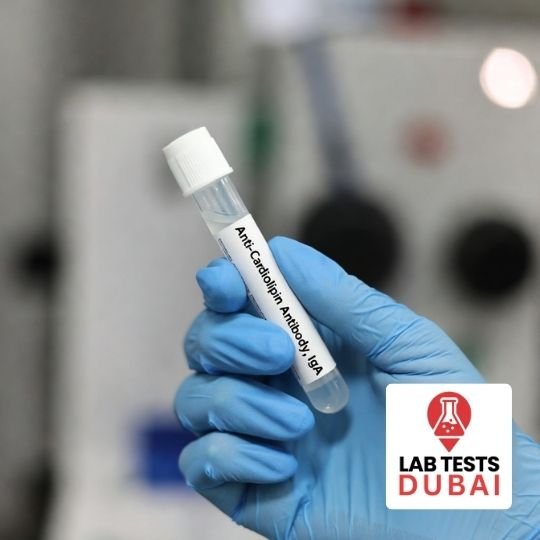
Anti-Cardiolipin Antibody IgA Test – Accurate Autoimmune Blood Testing
280,00 د.إ
The Anti-Cardiolipin Antibody, IgA test is used to detect IgA-class autoantibodies against cardiolipin, aiding in the evaluation of autoimmune disorders such as antiphospholipid syndrome (APS).
Sample Type : Serum
Methodology : Enzyme-immunoassay
TAT : 7 Days
Description
Anti-Cardiolipin Antibody, IgA Test – Accurate Detection of Hidden Autoimmune Risk
The Anti-Cardiolipin Antibody, IgA Test from Lab Tests Dubai is a specialized blood test that detects IgA-class antibodies against cardiolipin, a phospholipid targeted in autoimmune disorders like Antiphospholipid Syndrome (APS).
While IgG and IgM anti-cardiolipin antibodies are most commonly tested, IgA antibodies are increasingly recognized as clinically significant, especially in patients with classic APS symptoms but negative IgG/IgM results.
This test is essential for:
- Women with recurrent miscarriages or stillbirth
- Patients with unexplained blood clots (DVT, stroke, PE)
- Individuals with systemic lupus erythematosus (SLE) or other autoimmune diseases
- Those with negative standard APS panels but strong clinical suspicion
Using high-precision enzyme immunoassay (EIA) technology, this serum-based test delivers accurate results within 7 days, helping rheumatologists, obstetricians, and hematologists uncover hidden autoimmune causes of clotting and pregnancy loss.
Available with home blood collection, Lab Tests Dubai ensures fast, accurate, and stress-free testing, so you can get answers without disruption to your care.
Why You Need This Test
If you’ve had miscarriages, clots, or a stroke, but your standard APS panel was negative—this test could reveal a missed IgA-mediated autoimmune disorder.
You need the Anti-Cardiolipin IgA Test if:
- You’ve had two or more unexplained miscarriages before 10 weeks
- You’ve experienced stillbirth, preeclampsia, or IUGR before 34 weeks
- You’ve had DVT, pulmonary embolism, or stroke under age 50
- You have SLE (lupus) and are being screened for APS
- Your IgG and IgM anti-cardiolipin tests were negative, but symptoms persist
- You have livedo reticularis, low platelets, or prolonged aPTT
This test helps:
- Complete the APS antibody panel
- Avoid false-negative diagnoses
- Guide treatment with blood thinners (e.g., heparin, aspirin)
- Improve pregnancy outcomes
Early detection = better protection against clots and pregnancy loss.
Symptoms That Indicate This Test
Consider the Anti-Cardiolipin IgA Test if you experience:
✅ For Pregnancy Complications:
- Recurrent early or late miscarriages
- Unexplained stillbirth
- Severe preeclampsia or eclampsia
- Intrauterine growth restriction (IUGR)
✅ For Thrombotic Events:
- Deep vein thrombosis (DVT) – leg pain, swelling
- Pulmonary embolism (PE) – sudden breathlessness
- Stroke or TIA at a young age (<50)
- Heart attack without traditional risk factors
✅ For Autoimmune & Blood Disorders:
- Low platelet count (thrombocytopenia)
- Livedo reticularis – net-like purple skin rash
- SLE or other autoimmune diagnosis
- Prolonged aPTT (clotting test) with no cause
These signs may point to APS, and IgA antibodies may be the missing clue.
Natural Production: How IgA Antibodies Contribute to Autoimmune Clotting
Cardiolipin is a phospholipid found in mitochondrial membranes and platelet surfaces. It plays no direct role in clotting, but when bound by autoantibodies, it triggers pro-coagulant activity.
In Antiphospholipid Syndrome (APS), the immune system produces autoantibodies (IgG, IgM, or IgA) that:
- Bind to cardiolipin in the presence of beta-2 glycoprotein I (β2GPI)
- Activate platelets and endothelial cells
- Promote excessive clotting and placental inflammation
Why IgA Matters:
- Up to 10–15% of APS patients are positive only for IgA
- Often missed if labs only test IgG and IgM
- Strongly associated with pregnancy morbidity and thrombosis
Diagnostic Criteria (Revised Sapporo Criteria):
- Must have one clinical event (clot or pregnancy loss) AND
- Positive antibody test (IgG, IgM, or IgA anti-cardiolipin or anti-β2GPI) on two occasions, 12 weeks apart
This test closes the diagnostic gap for seronegative APS suspects.
What Happens If Untreated? Risks of Ignoring IgA Antibodies
Ignoring positive anti-cardiolipin IgA can lead to:
⚠️ Recurrent Miscarriages – without treatment, live birth rate <20%
⚠️ Life-Threatening Blood Clots – PE, stroke, heart attack
⚠️ Catastrophic APS – multi-organ failure from widespread clots
⚠️ Preeclampsia & Placental Insufficiency – risking baby’s health
⚠️ Chronic Organ Damage – from microthrombi in kidneys, brain, skin
The good news? APS is treatable with:
- Low-dose aspirin + heparin during pregnancy
- Warfarin or DOACs for clot prevention
- Close monitoring by rheumatology and maternal-fetal medicine
Early testing = higher chance of healthy pregnancy and clot-free life.
How to Prepare for the Test
To ensure accurate results:
✅ No fasting required
✅ Continue your regular medications, but inform your doctor
✅ Do not repeat the test within 12 weeks unless clinically indicated
✅ Inform your doctor of:
- Recent infections or vaccinations
- Current anticoagulant use (warfarin, heparin)
- History of lupus or autoimmune disease
A serum blood sample is collected via standard draw, available at our labs or via home collection.
Test Overview: Enzyme Immunoassay Method
Interpretation:
- <10 U/mL → Negative
- 10–39 U/mL → Low positive
- 40–80 U/mL → Moderate positive
- >80 U/mL → High positive (strong clinical significance)
Note: A single positive test is not diagnostic, must be confirmed after 12 weeks.
Benefits of the Anti-Cardiolipin IgA Test
🔹 Complete APS Screening
Catch cases missed by IgG/IgM-only panels.
🔹 Pregnancy Protection
Identify hidden causes of miscarriage and stillbirth.
🔹 Clot Prevention
Start anticoagulation before a life-threatening event.
🔹 Autoimmune Clarity
Support diagnosis in lupus and other connective tissue diseases.
🔹 Personalized Treatment Planning
Guide use of heparin, aspirin, or warfarin.
If you’re tired of unexplained losses, clots, or fear of stroke, the Anti-Cardiolipin IgA Test gives you the answers you need in just 7 days.
Frequently Asked Questions – Anti-Cardiolipin Antibody IgA Test
What is the Anti-Cardiolipin Antibody IgA test?
This blood test detects IgA-class autoantibodies against cardiolipin, a phospholipid involved in cell membrane structure. These antibodies are associated with antiphospholipid syndrome (APS), an autoimmune condition that increases the risk of abnormal blood clots, recurrent miscarriages, and pregnancy complications.
Why test for IgA if IgG and IgM are more common?
While IgG and IgM anti-cardiolipin antibodies are routinely tested, up to 15% of APS patients test positive only for IgA. These individuals may be missed if IgA is not included, especially those with recurrent pregnancy loss or unexplained clots but negative standard panels. Testing IgA ensures a complete autoimmune workup.
When should I get this test?
Consider testing if you have:
– Two or more unexplained miscarriages before 10 weeks
– Stillbirth or severe preeclampsia before 34 weeks
– Unexplained blood clots (DVT, stroke, pulmonary embolism)
– A diagnosis of lupus (SLE) or other autoimmune disease
– Negative IgG/IgM anti-cardiolipin tests but strong clinical suspicion of APS
Do I need to fast before the test?
No fasting is required. You can eat and drink normally before your blood draw. No special preparation is necessary.
How soon will I get my results?
Thanks to enzyme-immunoassay (EIA) methodology, results are typically available within 7 business days. You’ll receive a detailed report showing your antibody level and whether it falls within the normal, low-positive, or high-positive range.
Is one positive test enough to diagnose APS?
No. According to international criteria (Revised Sapporo Criteria), APS requires:
– One clinical event (e.g., clot or pregnancy loss) AND
– Persistent antibody positivity on two separate occasions at least 12 weeks apart.
A single positive IgA result is not diagnostic—but it warrants repeat testing and clinical correlation.




Reviews
There are no reviews yet.