
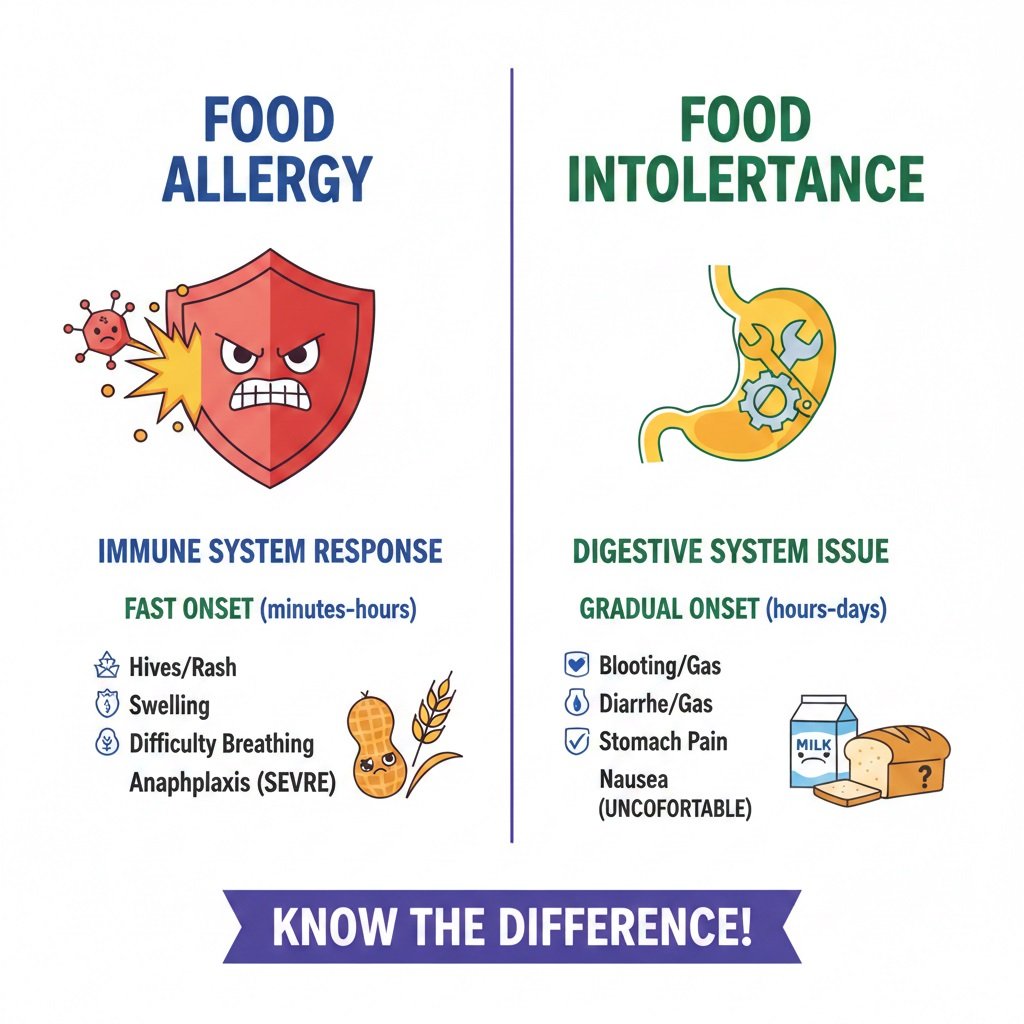
Is It a Food Allergy or Intolerance? The Critical Difference That Could Save Your Life
They might look similar in the bathroom, but in your body, they are two completely different mechanisms. Here is how to tell the difference, and why testing matters.
You eat a meal. An hour later, your stomach is cramping, your skin feels itchy, and you’re regretting that second helping.
Your first thought is likely: “I must be allergic to that.”
But are you? Or is it just an intolerance?
While the terms “food allergy” and “food intolerance” are often used interchangeably in casual conversation, in the medical world, they represent two vastly different things. One is a potentially life-threatening immune system malfunction; the other is a frustrating, usually manageable digestive issue.
Confusing the two isn’t just a vocabulary error, it can lead to unnecessary dietary restrictions, or worse, a dangerous medical emergency.
Here is how to tell them apart, and why getting the right test from Lab Tests Dubai is the only way to know for sure.
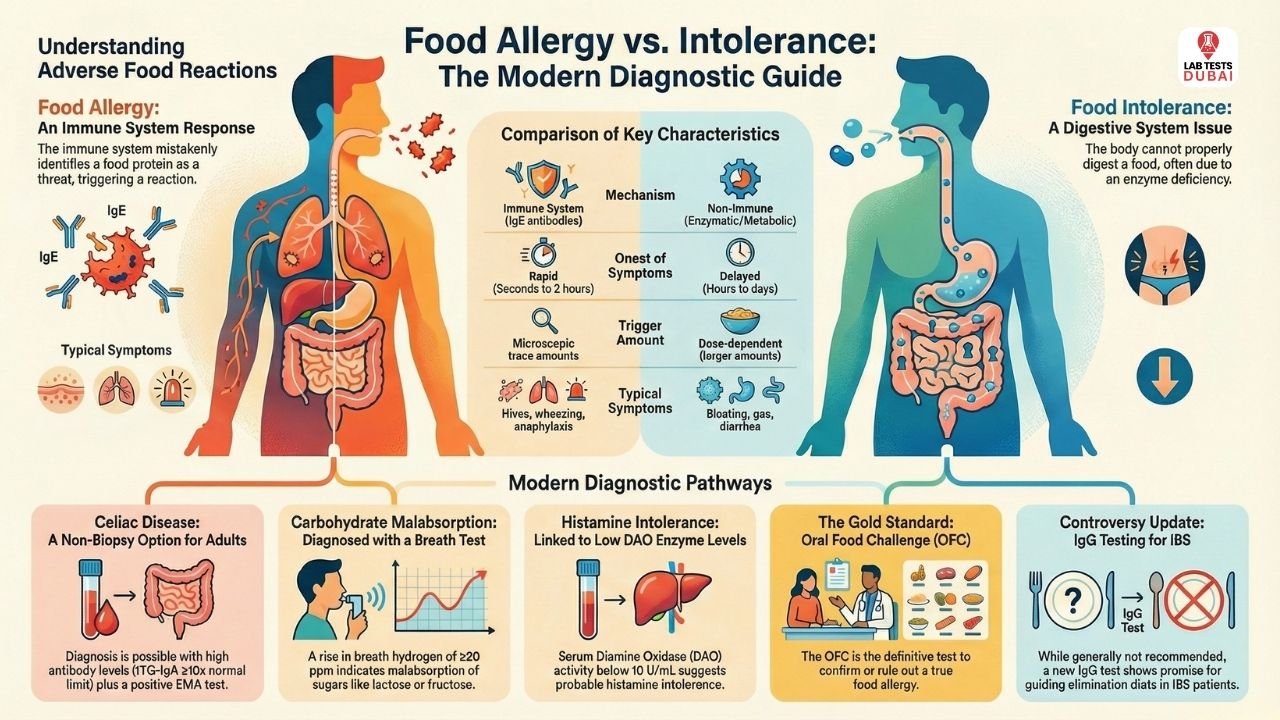
The fundamental Difference: Immune System vs. Digestive System
The easiest way to understand the difference is to look at where the reaction happens.
Food Allergy (The Immune System Mistake) A food allergy occurs when your immune system mistakenly identifies a harmless food protein (like a peanut or a shrimp protein) as a dangerous invader.
- The Mechanism: Your body launches an all-out attack by producing specific antibodies called IgE (Immunoglobulin E).
- The Trigger: Even a microscopic amount of the food can trigger this reaction.
- The Result: This is a systemic reaction. It can affect your skin, your breathing, your heart, and your gut simultaneously.
Food Intolerance (The Digestive Struggle) Intolerance is usually (though not always) about the digestive system’s inability to process a specific food.
- The Mechanism: You might lack a specific enzyme (like lactase for dairy), or your gut might simply be sensitive to certain chemicals (like histamine in wine or gluten).
- The Trigger: It is often dose-dependent. You might handle a tiny bit of cheese, but a slice of pizza sends you running to the bathroom.
- The Result: The reaction is generally localized to the digestive tract, bloating, gas, diarrhea, pain. It is miserable, but it is rarely fatal.
Symptoms: How They Diverge
Because both conditions affect the gut, there is overlap. But the presence of specific symptoms usually gives the game away.
Common Signs of FOOD ALLERGY (Immediate & Severe):
- Skin: Hives, redness, eczema, or sudden swelling of the lips/face.
- Respiratory: Wheezing, nasal congestion, trouble breathing, or throat tightness.
- Cardiovascular: Drop in blood pressure, dizziness, or fainting.
- Digestive: Nausea, vomiting (often sudden and violent).
- The Big One: Anaphylaxis. This is a severe, potentially life-threatening allergic reaction that requires immediate medical attention (often an epinephrine shot).
Common Signs of FOOD INTOLERANCE (Delayed & Uncomfortable):
- Digestive: Bloating, gas, stomach cramps, diarrhea, or constipation.
- General: Fatigue, headaches, brain fog, or a feeling of “heaviness.”
- Timing: Symptoms usually appear hours later (or even the next day), whereas allergy symptoms often appear within minutes to two hours.
Why Testing Matters (And Why Guessing Is Dangerous)
This is the most important section of this article.
Scenario A: You think it’s an intolerance, but it’s an allergy. You decide to “test your limits” by eating a small amount of the food. If it is a true allergy (especially to nuts or shellfish), that small amount could send you into anaphylactic shock. You cannot build a tolerance to an IgE allergy by exposure.
Scenario B: You think it’s an allergy, but it’s an intolerance. You spend years avoiding perfectly healthy foods (like dairy or wheat) because you had a bad reaction once. This leads to nutritional deficiencies and a lower quality of life. You might never realize that a simple enzyme pill (like Lactaid) could solve your problem.
You cannot tell the difference by how you feel alone. You need data.
The Gold Standard: Testing with Lab Tests Dubai
At Lab Tests Dubai, we don’t guess. We test.
If you suspect you have a food allergy, we offer the Allergy Food Panel – 44 Foods (IgE Test).
This is the definitive test for true allergies.
- What it does: It scans your blood for IgE antibodies against 44 common foods, including nuts, dairy, eggs, shellfish, and gluten-containing grains.
- Why it works: It identifies exactly what your immune system is fighting. If you test positive for shrimp IgE, you know you need to carry an EpiPen and avoid shrimp strictly. If you test negative, you might just be dealing with an intolerance (or something else entirely).
For intolerances, while there is no single blood test as definitive as the IgE test, eliminating IgE-mediated allergies first is the critical first step. Once an allergy is ruled out, you and your doctor can explore other causes like enzyme deficiency or gut health.
So, Which One Do You Have?
Ask yourself these three questions:
- Timing: Do symptoms happen within minutes of eating? (Points to Allergy)
- Severity: Do you get hives, swelling, or trouble breathing? (Points to Allergy)
- Dose: Can you eat a tiny bit of the food without problem, but get sick with a large amount? (Points to Intolerance)
If you answered “Yes” to the first two, you need to book an allergy test immediately.
Eat with Confidence, Not Fear
Food should be a source of nourishment and joy, not a source of anxiety. Whether your body is fighting a food or just struggling to digest it, knowing the truth is the first step toward relief.